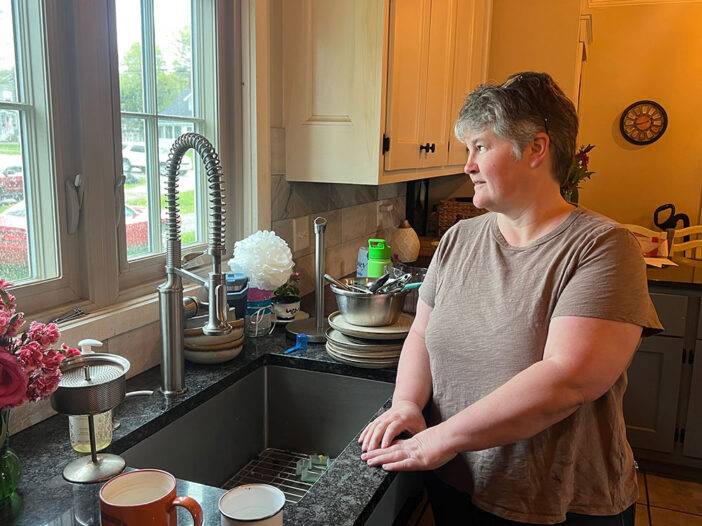
For a latecomer to Waldoboro (here only since 2020), Becky Stephens is very well-known. Last year she was voted onto the Select Board. She’s been a physical therapist in town for close to fifteen years here, first with Maine Health, then at RSU40. She has eight children and a full roster of after-school activities. She’s a foster parent. Growing up, Becky never considered herself poor because she never wanted for food or toys. But her parents had divorced when she was three, and her newly single mom was making do on housekeeping wages. When Becky looks at old photos, her mother is tiny and thin. When Becky was ten, her mother remarried, and they all moved to Camden settling in a trailer at a trailer park. It felt normal until her class at Camden High was discussing where to site a hypothetical trailer park. While her classmates universally supported the park, they didn’t want it in their neighborhood. So, it’s no wonder that in Select Board meetings, she is impassioned when the business at hand is an eviction or a request for funds by the Food Pantry or Healthy Kids Maine. Those are things close to the bone. But lest this look easy, Becky is the first to give her husband John the credit for being the person who makes all this happen. He’s the one who steps in to drive the kids to after-school activities, tidies the house, or readies the dinner. Sometimes it takes two, not one.
When I was a teenager, we had a relative whose children needed to be in foster care, and my parents took in one of them to our home, and she lived with us. They kept her from living with strangers. My parents had instilled in me that in life, you should give back. I always thought it was so kind to meet the need of a child. I always kept it in my head.
It wasn’t until I was out of school and making more money, that I broached it again with John, my husband. We lived in a beautiful Colonial, our kids were starting to leave, and we had all these rooms. I was feeling really blessed.
But I knew John worried about our getting into something that might be too much for us, so I suggested we try doing what they call “respite fostering,” that is, filling in when foster parents need a short break. So, we got trained. We were going to do respite fostering.
Then the calls started coming. They’d start like this: “We have a child who has to leave their home, but we don’t want them to have to change schools — and you live in their district.”
How could we say no? So, right out of the gate, we were taking placements.
It was easy and hard. Easy is the lovely child who comes into your home, wants smiles and enjoys being read to, and transitions nicely at bedtime.
Hard is having a child in your home for a year or two, and you love them, appreciating all the parts they are as a person. And then they move.
They might have arrived angry, believing they are there with you because it’s something they did. It wasn’t their fault, but they own it anyway — maybe they told someone that something happened in their house that led to their having to leave; maybe the things going on in their house made it unsafe for them; maybe everything going on at home caused them to act out. Whatever it was, they believe they’re the reason they got sent away. And you have to help them see that this is not so. It wasn’t their fault.
Just about every child we’ve fostered has come from a home where substance abuse, drugs or alcohol, was a problem. I don’t have the figures, but I think the need for foster care has exploded in Maine. Thirty years ago, when a mother or a family was struggling, a member of the family could step in. But these days, loving families are already exhausted in dealing with a loved one’s addiction and everything that it entails, and so overwhelmed that they can’t even think about caring for a child.
Kids come with lots of emotions like anger, sadness, and fear. Some children even think it’s not okay to be happy. Helping them identify how they’re feeling is one of the things that John and I try to do. And still, there are moments when a child might be reacting over the top, and I’m like, “What is going on?”
And John will give me a look that says, “This is a lot for this child. And we don’t know what this child has been through.”
Older kids have a little more insight into what they’re feeling which is usually a lot of anger and sadness, and yet relief at being in a safe place. After a while, though, they’ll start to trust you. And then they’ll throw out something negative about their parents and expect you to hop on board with them. But you say, “But your mom loves you. She’s just not in a place to take care of you right now.” And they’re not expecting that.
And then you say, “And you love your mom. But you’re not in a place to be able to live safely with her right now.” And the walls come down.
To be a foster parent – it truly is a calling. If I didn’t have that strength and the grace of kindness, I wouldn’t be doing this. You cannot pour your love and attention and your whole self into such heart-wrenching circumstances without being able to say, “I don’t understand why we’re in this, Lord, but I know you have a plan, and that that somehow it’s going to be okay.”
I’ve always said that anger is a sister to grief. There’s a lot of grief in fostering. Kids are grieving because they have just lost everything that they know and that is comfortable for them. Parents are grieving because they are in circumstances that led to their children being taken away from them. And we are grieving every time a child leaves our home at the end of their stay. It’s the hardest part of fostering.
Kids transition out in many ways. They can re-unify with their family at home because their parents have taken the steps to show that they can keep their child safe and do the appropriate things. Or they can move in with a family member – a grandmother or an aunt or uncle who is somebody who can take care of that child. Or you can adopt that child, which is the way of keeping them forever.
But for all the others, each time a child leaves, I think, “I can never again put myself in this grief and heartbreak.” And I’m looking at my spouse and I’m looking at my children in the home, and we’re all heartbroken as if somebody passed away, because it’s like poof! A child is gone from our home, and we all have to re-adjust to what home looks like now, and I think, “I just can’t do it anymore, I can’t!”
And then the phone rings.
And there’s a child in need.
And the ability to say no to such a child is not inherently within me.
Leave a Reply