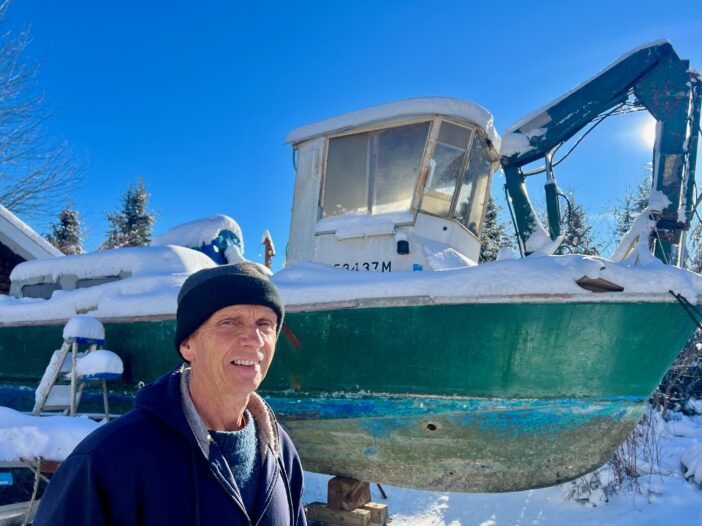
Bay Creamer is the youngest of Arthur and Beryle Creamer’s children, and like his siblings, he’s worked all his life, starting from about seven or eight years old, digging clams. As Bay describes it, it wasn’t a bad childhood. Each child always had their own money, and everyone paid in cash because no one had a credit card, and that saved the family a lot of money. Clamming is still in Bay’s blood. He did it all through high school, technical college, and after. He no longer clams but still has his license. It’s an option he could always return to. He studied automotive science in technical college, so perhaps it’s not too far a stretch that some years later, he bought tractor-trailer. He trucked when times were lean, first for Dysart, and then for Portland Air Freight and Northeast Transport. It was the perfect, well-paying part-time job. Finally, and this is the subject of this piece, Bay added seaweed harvesting to his roster.
One day, a fella down the road, Ken Dondlinger, he says to me, “Bay – how about doing seaweed?” We had all sorts of ideas together, but in the end we never got there.
But I kept thinking about it, and finally I went in to see Bob Morse, the owner of North American Kelp here in Waldoboro. He said, “Well, right now, I don’t really need it, but I’ll think about it.”
I thought, “Well, I know where that’s going,” and I went down to Newfoundland with my girlfriend. And while we was gone, Bob called my father, and said, “We would like to try that with Bay.”
But my father never told me. On my own I went up there and asked about it, and Bob said, “Well, I called ya, but you never got the message. We’re ready to try it.” And that was 35 years ago, and I’m still with them.
If you knew only a quarter of what I went through to get it…well, I never used to talk with anybody, but now they say I talk too much. But that’s because I have so many stories.
Like, one year, it was brutally cold, and everything froze up. Even Friendship Harbor froze. You couldn’t get no seaweed. At least from here. Well, George Seaver called up and said, “Bay, can you help us out?”
I’m not like this now, but back then, there was nothing I couldn’t do. If I could get weed, I’d get it. That year I had my big boat out in St. George in what they call Long Cove, and for four weeks, I’d be standing in my skiff, jumping up and down breaking ice ‘til it was broken so I could get all the way to my big boat and I’d break out ice in that to get enough seaweed and I’d come back, go out in my skiff, too, to harvest weed by hand. And the next day I’d do the same thing, and break ice all the way out and back.
Another time I went out to Islesboro, and it was probably 40 mph, northwest wind, cold! The next day I see Craig who used to usher out the cars on and off ferry and he says, “You know, Bay, I felt sorry for you. That wind! That cold! It was all white out there and the swells!”
And I says, “You know what, Craig? I felt sorry for me, too.”
Another day, people from all over were calling for me. They thought I’d drowneded, wasn’t going to make it. Bob Morse’s sister, who used to watch for me all the time, called saying, “Bob, Bay’s not back. He’s not off the dock, it’s northeast, it’s blowing, it’s snowing bad. I don’t think he’s going to make it; I don’t think he made it.”
And he says to her, “Lucinda, I know Bay. He’s went to Boothbay Harbor, he’s towing by the Townsend Gut, so he’s alright. He’s not drowneded.”
And I was out, in the pitch dark and driving snow, and coming up the river.
Last year I had the boat up in October and didn’t get it out until May because of the all the stuff I needed to do. And that’s when I said, “This is it. These winters are too wild. The storms have too much power. There’s too much wind.”
This year I’ve taken the boat out, and maybe once it goes in, I’ll take it out in October again. It’s not healthy for me to be out there anymore. Too much cold, and the winds are so much stronger now. And the tides! They are two or three feet higher now. Everywhere I go. Most people are like, “Really?” They think I’m a tree hugger or something.
No! The sea levels are seriously changing. Where I take the seaweed out, there’s a culvert. Usually, when the tide was supposed to be nine feet, it would be up to a certain level. Now, it’s a foot and a half more all the time, and the tide calendars don’t show this. And I see this everywhere I go.
The harvesting is different, too. Back in the beginning, it was unlimited. For the first four years we just ripped it off by hand and into the nets over the side of the boat. There was so much of it, we didn’t care. I didn’t care.
That was before I knew what seaweed was all about, and how long it takes to grow back. Back then, I was also the only one harvesting seaweed around with a big boat. When I got the harvester for my boat, I worked from Wiscasset to Searsport. But I always rotated where I was harvesting, coming back only after three, four, or five years later. But still, landowners along the shore would come down, concerned about it, and I’d tell them what I was doing, and that I was harvesting in different years. And they’d see how I was doing it, leaving not just the required sixteen inches but two, two and a half feet behind, and they’d believe me. They trusted and respected me, and they never bothered me.
Well, guess what? Another harvester come in. And we went from harvesting into a 65 series Chevy truck to a tandem truck to pick it up.
Then another harvester come into it. And everybody from their houses would see us. Then it grew to four, five or more people out there, from Bremen, Round Pond, Port Clyde, St. George, even as far as Brunswick.
These harvesters chew up a lot of weed. They’re working in territory that I used to harvest in. And now there’s a 48-foot trailer, tri-axel, with 100, 000 grow weight on it for hauling out the seaweed. All of this makes landowners worried.
But who owns the seaweed? We don’t know. Clammers are allowed to dig below the water line. Wormers are allowed, too. So, what about the seaweed harvesters?
Right now, a landowner can call the warden, but they’d learn that they really have no rights. The harvester is the one who has the right to cut.
But people’s complaints are why we’re in court. The case was heard in 2024, but DMR still hasn’t made a decision. So right now, we’re waiting.
Leave a Reply