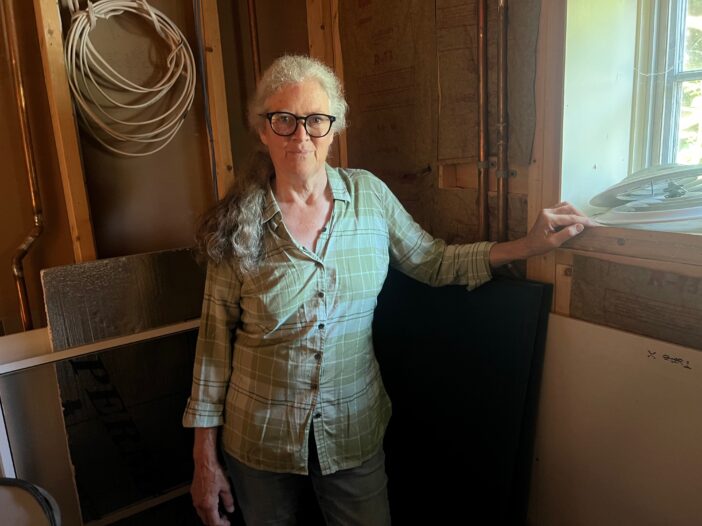
“But what can one person do?” “A lot,” is the answer, at least if you’re talking about Barbara Boardman how she coordinated the renovations of The Waldo, to bring it back after its 2015 closure. Barbara is a woman who never stops moving so you might run into her in town or almost anywhere. On the other hand, you might not, because her retirement plan is growing strawberries and hardy kiwis. But if you get so lucky as to have a conversation with her, beware! Before you know it, you might find yourself volunteering for any of the projects at The Waldo that she has lined up which include painting two exterior doors that need that last coat; mowing the small plots out front and out the back; finishing the spackling and painting of the almost-built bathroom for performers after a concert; installing shelves for supplies; or framing an extra restroom and dressing rooms for musicians. She will tell you, “It’s so important.” And it is. And then she will thank you with a slow smile.
In the early days of our life in Waldoboro, when we were busy with family, work and aging parents, I would drive by the Waldo Theatre and wonder what was going on in there. I think I’d only been in the building a couple of times, to hear things like the Maine fiddle thing and the Paul Winter Consort.
But then around 2014 or 2015, I started hearing stories. The roof was leaking. Water was infiltrating into the basement, too. So, when it closed a year or so later, people were asking, “What is the plan for the Waldo?”
I fell in with bunch of like-minded people who felt the same, that this building had to be operating. It had to be a magnet for arts activities, community activities, town activities. I just wanted to see people sitting in chairs and talking to each other. I think we all felt that it if it could get up and going again, it could also be an economic engine for the town.
Together, we were able assume charge of the building and form our own non-profit. We had to learn it all from scratch. None of us had been on a board before. We had never even raised funds.
But I loved the building architecturally. This is one of the few buildings still intact by Benjamin Schlanger, its architect. I love the modernism of it! It blows my mind how simple it is and how effective it still is, too. The inside is fabulous.
But we didn’t know what we were getting into. When we finally got to look at it, the moisture was so bad that if you put your hand on the wall, your fingers went through it.
I wasn’t intimidated. I was familiar with how buildings work, and because I’d run my own architectural and landscape design business for many years, I knew how buildings worked. I understood how you have to go from one step to another and do it in an efficient way. I knew how to do renovation. And I have always loved building and repairing things. Even so, it was steep learning curve for all of us.
But because of my experience, people were totally willing to let me take on the burden of coordinating it. “Just tell me when to show up,” they said, and they would show up.
Most historic building renovations start with a capital campaign. But we were desperate to get the water out of the building, so the first thing I did was call up people in town and say, “I need 250 bucks from each of you to put in de-humidifiers throughout the building.”
And everyone said, “Sure.” Sometimes, you just have to ask.
The minute we had the funds for a roof, the roof went on. Things happened in little chunks as we raised the money. It was only later that we started getting small grants from places like Maine Community Foundation.
There are so many things that people will never see. Like the up-hill side of the building that Jim Derby dug out and waterproofed, practically all by hand. God bless him for the projects he was willing to take on, from running the water out of there and then not allowing it to come in ever again. Jim Derby is such a saint. That is just one of the things you don’t see. But there are a lot of them. Fixing them allows us to pass the building on to the next generation.
At the same time, we were building a crew of volunteers. And people would come and bring their friends, too. The first thing they did was take everything out from the whole building. All the rugs in the lobby and orchestra and even upstairs had to be torn up and thrown out. The sheetrock in the downstairs that was soggy from flooding. The insulation from the walls. We removed all the theatre stuff jammed into every nook and cranny, like old sets, old costumes and tons of clothing. We had to strip out all the old acoustic padding on the back walls and the balcony walls. We removed anything that could hold moisture. I was always amazed that people were willing to do all these things.
But there were other times when there weren’t enough people to get a job done efficiently, and the project would drag out. If we had contracted that work out, the job would have finished faster. But we didn’t have the money. That’s why we couldn’t have done this without those volunteers.
We even put in all new light bars. Volunteers and Jim Derby brought the timbers up the projection stairs and into the attic in order to hang the light bars. That they were able to do it – well, it was a glorious moment.
We also had discoveries. In the lobby where we’d lifted the rugs, it was all carpet glue and a dull gray. So, we got down on our hands and knees to scrape it off. And when Bruce Mettrick, who’d rented a buffer, started work on it, it was like, “Holy smokes! This thing is beautiful!” Underneath, there was a terrazzo band around the perimeter. Things like that happened because people were willing to take it on and fix it.
I send kudos to all the volunteers in town because it’s amazing what is generated and created by volunteers. And it’s all mostly stuff you do not see. I am humbled by how much they accomplished. And now, when you walk into The Waldo, it looks all new and shiny and refurbished.
And on the outside, The Waldo does seem super-successful. And in some ways, it is. Our grants, specifically used for education, keep that program going, an absolutely key program for us. I love seeing what’s happening in the schools and in the summer camp.
But we don’t have a cushion. And that alarms me. At any moment, our furnace, which was installed in the 1980s, is going to go. If that happens, we’ll have to stop all activity. That would literally stop us in our tracks. An estimate we got a few years back was $58,000 for a new boiler. We don’t have that money.
If the air conditioning goes, that also would shut us down. Air-conditioning is not a luxury. It’s not like we can just throw open the windows. And the price for that is $61,000, at least that was we heard several years ago.
We can ask people to paint and to do many things, but some stuff requires real money. Oh my gosh, it would be great to have funds for that emergency when it comes.
Leave a Reply