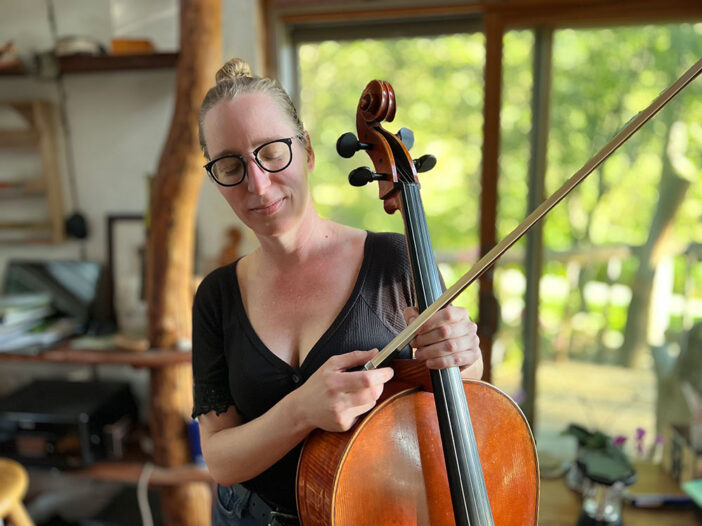
Karate teacher, shepherdess, wool spinner, Japanese longbow student, eight-and nine-ball pool player, dressage rider. These are just a smattering of the things that cellist April Reed-Cox has done or is doing now. Music, however, has been the core of her life. At four, she began playing the cello. By sixteen, she was playing in the graduate school string quartet of her college. Today, she plays with the Bangor Symphony Orchestra, the Casco Bay Strings, the Windfern Ensemble and at Broad Bay Congregational in addition to teaching at the Bay Chamber Music School in Rockport. And this fall, she’s performing three solo recitals across the state. Back in the 1970s, April’s grandparents moved to Waldoboro on a small farm to breed champion Nubian show goats. Each winter and summer her family would come to Waldoboro from South Carolina, either to ski or vacation. During one visit, her mother saw how much her parents needed help. She asked April to move with her and build a house, too. April, who had just finished her masters and finalized the divorce from her first marriage, was like, “Sure!” It was 2009. The first year April, her son and her mother lived in an uninsulated, one-room cabin with their two dogs and seven cats while they were building their new home. April was also driving back and forth with her son to play with the Greenville Symphony Orchestra, fourteen trips. A year later, they were in the new house, and April was teaching. Most of all, she playing at the Narrows Tavern. Because that was the place that sparked off all the connections that’s led her where she is today.
I didn’t know anyone in Waldoboro when I first arrived. But my grandfather, who used to frequent the Narrows Tavern, finally said, “Why don’t you go down to the Tavern and show them how to play?” The next Tuesday I packed my cello, went down, and stood in a corner. I listened for a minute and then asked Nancy Jones if I could sit in. I’d never played any folk music except some fiddle tunes. I’d never played with guitarists. I was classically trained, with a Master’s degree in musical performance, and I was sitting down and playing folk music in a bar.
It’s four chords and the Lord — when you put folk music against Stravinsky or Bach. It’s so freeing. I hear all the notes in that chord. Playing like that is like riding a river. You can see what’s coming next, and you choose your line through the rapids.
The Rusty Hinges were and are awesome. They play the old songs that I love. Their sound is raw and amorphous, and sometimes they’ll pull apart and then come back together, and everyone sings along with them. It’s beautiful. I did that for a couple of Tuesdays. But then Brian Dunn invited me to play with him and Oren Robinson on Fridays, and that’s how the Alehouse String Band was formed.
The three of us played for years and years until Covid killed it. But because of the Narrows and the Alehouse String Band, I’m playing in all these other places.
Music in its basic description is controlled sound and silence. The music on the page has no energy. It’s just raw potential. Until you are causing a sound to happen, or to stop happening, it’s all potential until you make the first sound. Often that first sound is an inhalation.
It’s not written anywhere, but every musician I know, when they go to start playing, they inhale, and that’s it: we’re all together. I’m breathing in the room, breathing in the energy, breathing in the air and taking in the space, and then we have this thing called music. It’s not me using all of my own energy. It’s me using the energy of the audience and of the space and then giving it back along with my own energy.
But I don’t feel what I do with music is amazing. Playing music has always come easily to me. But inside, I have a whole litany of everything I missed or did wrong. It’s why I struggle with praise. But then I remember that people are hearing all the things I did right.
Maybe that’s why I have a war inside of me each time I sit down to practice. I’m scared how good I could be, and I’m scared how much I can fail. It’s still the hardest part of the day, and I want that to change.
I have a new cello! My whole life, I’ve been playing and competing on my original cello, a student instrument. Teachers have been telling me since I was eighteen that I needed a professional-level cello. I’m 41 years old, and now I have one.
My cello named herself Zara and I think it’s because the sound she makes is reminiscent of the cellist Zara Nelsova’s, who recorded mostly in the ‘50s and ‘60s. Zara was flamboyant. Sometimes she played out of tune. But what she was trying to build and the story she was trying to tell was so incredible that it didn’t matter. You didn’t care. Her tone was that beautiful.
I tested thirty different cellos before Zara. In the beginning I was also trying different bows, but I kept coming back to this one bow. When the cello specialist of Carriage House Violin brought out the cello that he believed was for me, I took the bow and sat down in the performance hall to play. I played one chord.
I stood up, picked up the cello and gasped. That single chord, the way it intensified – it went through my body. I knew immediately it was the cello and bow for me.
The tools we use are a part of us. And we are a part of them. My bow is an extension of my right arm. And my cello, it’s like I have my body, but then I have my body. My cello is a part of my body.
Leave a Reply