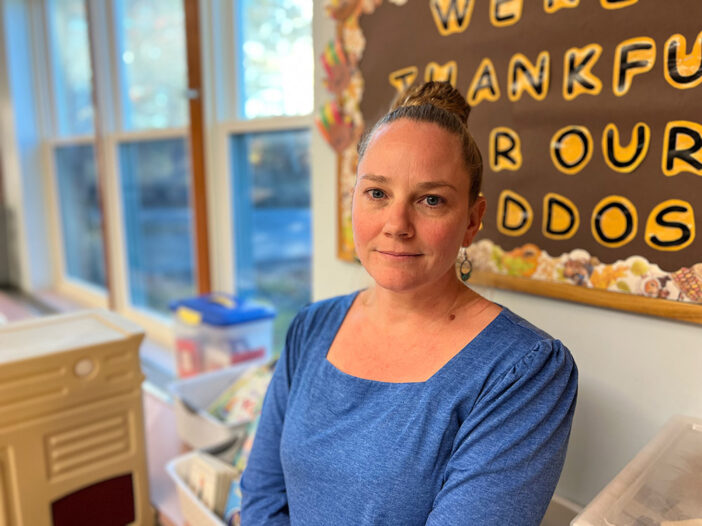
Andrea Curtis grew up in Waldoboro wanting to leave the day she graduated from Medomak Valley High School, and head out West in a VW bus. But in April of her senior year, Andrea decided she had nothing to lose by applying to college, and Farmington had an opening in their special education program. Andrea liked that the need was great, and even more, that it would be challenging. At college, she studied how to approach severe learning disabilities holistically. She became an investigator to discern what children were saying. After graduation, she worked with pre-school kids, from infancy to five years old. Seven years later, she transitioned into elementary special education where she still is. She got an MS. And she’s taken on coaching Special Olympics. She calls her kiddoes rock stars. Waldoboro could call her one, too. Waldoboro’s school district has one of the highest percentages of special ed students in Maine, somewhere around 22% across its three schools. Student disabilities range from autism, hearing, sight or mobility impairments, seizure disorders to behavioral setbacks such as temper management. At Miller there are three tiers of special ed students. Andrea heads the tier for the earliest learners with the biggest deficits. As head, she both works with children and plus does the daily scheduling and the legal and supervisory record keeping. This is her 19th year in the field and she has lost none of her passion for the children and adults she works with. But she is also exhausted – a function of being chronically short of staff.
I think a big misconception in our special ed world is that if a student can play, walk, and swing on the swings, they don’t need help. People can glance at a kiddo and think, “That kid doesn’t need an adult all day long.” But in reality, that kiddo doesn’t have communication skills. My kiddoes often aren’t ready for academics in the classroom. We have a lot of non-verbal talkers. They are learning how to learn, and even more basic things like what it means when I say “look” or how to take directions in the classroom and engage — with each other and with the student body.
It’s their legal right to be with their non-disabled peers to the best of their ability. And I’ve worked to make sure all teachers at Miller know about special ed law, things like access and equality. There might not be the same outcomes but there must be the means to get there.
I’m so proud of our general ed students. If my kiddoes are in the classroom, they are welcomed warmly. Students yell, “Hi! Hi! You’re here!” They see the happiness of my kiddoes. They see the behavioral setbacks, too, and they just welcome them. On the playground, if a general ed student wanted to play with one of our students, they’d check in with an adult. But now, we tell them, “I don’t know. Ask him.” This is a big point of happiness for us. There are always students who are fearful, but that just gives us teaching opportunities.
On a good day, we have all students present and healthy, everyone’s at their best capacity, and all staff are present and ready to teach. On these days we can have individualized lessons here. And we can get our students out in the student community where they need to be, too so they can participate with their peers as much as they can. It could be as little as going by their classroom to say hello and or perhaps staying for the full morning meeting which could be 30 minutes. Some might stay for the lessons that follow. All students do recess with their homeroom and go to specials like art, music, and phys ed with the regular student body. With full attendance and great health, we can do these things. Even if we have huge behavioral issues, we have the staff on those days to control them. It makes for a wonderful day.
A bad day is when we’re short-staffed. For our kiddoes, it means we can’t take them to music, art or even to recess with their peers because we don’t have the people to get them there. For our staff, which is a team of teachers and wonderful special ed techs (aides), it means we are overwhelmed. We are supposed to have a 1:1 ratio between adult and student. When we don’t, which is a lot of the time, we can miss the triggers of an outburst to preempt it by distracting the kid, which works a lot.
We are trained in safety care, we know how to block, and we accept the risks. But we still have our hair pulled, are spit on, get beaten up and have feces thrown at us. If there’s an outburst, our techs are so wonderfully invested that even if they are about to go on break, they’ll skip it to make sure the kids are safe, and staff supported. This is how burn-out happens. No one is getting relief they need from what is already a stressful job. And my stress is that it will get too much, and they will quit.
But the real losers are the children. Without the staff, how can we push them to do better? A lot of days it feels like glorified day care when the best we can say is, “We kept them safe.” We want so much more for them. Our students deserve that.
I want to say to everybody: visit our schools. See what teachers are up against. We welcome ideas on how to get teachers to apply for jobs, how to keep teachers from quitting, how to bring people in to substitute in classes. And how we can support our teachers and staff and make them more visible. I want the whole community to see our school, and to stand up for our needs.
Leave a Reply