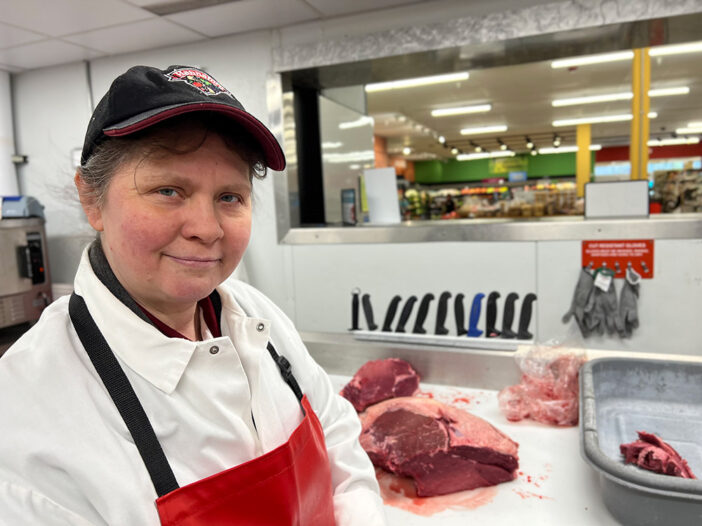
Amy Laweryson was working at Hannaford as a clerk when a butcher invited her to try her hand at cutting. She was only a few months into the job, and she leapt at the chance to learn something new. From there, she took off, learning and honing her craft from the old-time butchers there and at other nearby Hannafords, including Rockland, Camden, Boothbay and Waldoboro. It’s 27 years later and Amy is the Meat Operations Supervisor in the Waldoboro store where she still butchers Amy lives in Waldoboro which she describes as a big town with a small-town feel. It’s the county’s the most populous town, with citizenry scattered over 73 rural square miles. So, if you bump into a friend or acquaintance, the chances are it was at Hannaford. You could say it’s an unofficial town square. Hannaford, which opened in 1883 in Portland, set down stakes in Waldoboro in 1967. When the store renovated in 2016, it added on a third more space and 2,000 new products. Hannaford is one of Waldoboro’s largest emplouyers with the number at the Waldoboro store hovering around 150, full and part time. The meat department alone has four butchers, plus Amy on staff. Gone are the days of half sides hanging off hooks at Hannaford. For the last two decades or so, meat has arrived broken down into what’s called ‘the primal cuts,’ such as shoulders or boneless ribs. Butchers cut that meat into steaks, stew, and grinds that are then packaged and put in the cases that line the back of the supermarket. Amy is the daughter of two US Marines. Service is in her nature. She’s been a corrections officer for the Wiscasset jail, and a firefighter and EMT in Nobleboro. And it’s the value she lives at work -- for her customers, her staff and her store.
It’s a craft. It’s an art. I’ve loved it from my first day. You get this big lump of something and then you have to make something else out of it – something that looks right, something that you can sell, something that they can eat, something that’s correct. It’s an on-going creative process, and that’s fun.
Physically, the hardest part probably is throwing freight in the morning. Freight is the boxes, like prime rib boxes that go from 50 pounds to 100 depending on which prime rib you’re using, like, bone-in pork is always about 100 pounds a box. I’m no spring chicken but I love it. I still do it.
Then, I look at our case, see what we need to do, and jump on it so that when the customers come in, we got what they want and we’re ready to go. And if a customer wants something they see at another store, we will bring it in, so they don’t have to go to the bigger store to get what they need.
Then, we just maintain the case for the rest of the day. We cut as sales dictate. We do our grinds and stuff like that. We run the case. Only a few items come in pre-packaged like chicken, the cryo-packed meats, and all our Nature’s Promise selection.
I love doing bone-in pork. Most people don’t. Because of the size of the loin, it’s difficult to hold. And a lot of people are afraid of the saw, which is righteously so because she will bite you if you are not paying attention, for even a second. She’s going to wake you up and remind you that she’s there. Give me the saw and get out of the way. Maybe it’s the challenge, but I really like doing it.
Shoulder cuts are hard. It’s a tough cut to begin with. You have to give it some love before you can eat it, like marinate it or something before you pop it on the grill. But if you are just a little bit off in your cutting angle, then the meat is going to be very tough. You have to be pretty much dead on to have an edible steak in the case. I take a lot of pride in mine. Maybe it’s a small thing, but you’re putting it out there for the customer. That was ingrained in me from the beginning. Keeping this knowledge going forward is very important to me.
Times have changed greatly, and people have changed. Especially with COVID. People kind of shut down and didn’t want to be involved in anything. They would come in, do what they had to do, and get out. Then you had the ones that were just like, “How’re you doing?” And then we had some regulars that were absolute godsends, even with the whole 6-foot buffer we had. They’d stand twelve feet away and they’d wave or they’d yell, “Hey, I’m here.” Or the ones that used to come up and maybe shake your hand and give a little hug — but they couldn’t do that anymore so they did the elbow thing.
Just a couple of weeks ago we had a gentleman having a medical emergency on the front end. I’d worked as an EMT so when they called, I went up. We put him in a rescue position so he was in a better spot for the ambulance.
I had two customers that jumped right in without any thought or hesitation. There was a gentleman that helped me roll him over, and there was a woman that was using her clothes for pillows, and then taking off her coat and sweater to use as blankets, and it was just…THAT is why I am here. These people are here, so you have to be there for them.
It was so against everything we had been before: stay away, don’t touch, don’t get involved, don’t do anything. They just jumped right in. They rocked. I love them. I love all my customers.
It’s like the adage. If you do what you love, you never work a day in your life.
Leave a Reply