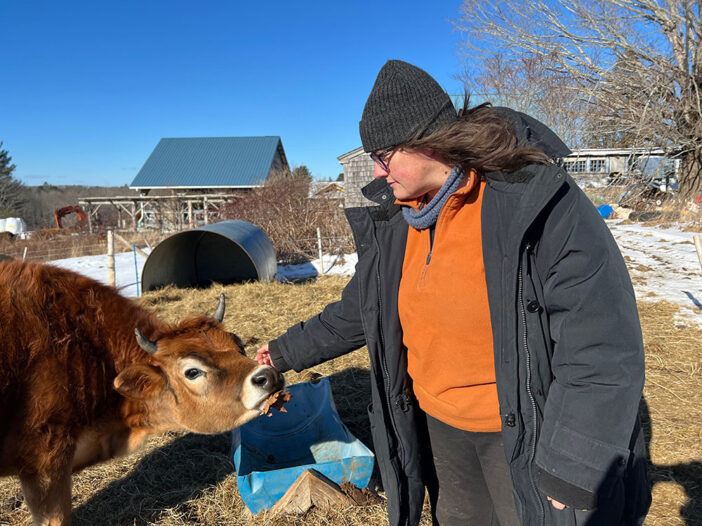
When you think of it, it’s kind of amazing that Allison Lakin found cheesemaking. After all, she was anthropologist of maritime cultures; a museum educator (at Mystic Seaport, Texas Maritime Museum, and the John & Mable Ringling Museum of Art), a lighting designer for theater and bands. She even used to be fluent in Japanese. So, it’s no wonder that sometime in the middle of her multi-faceted life that Allison took a break to do something different. She jumped into cheesemaking. And won awards. A few years later, she went back to museum work. But something had clicked while she was in the cheese world, and when she moved to Rockland, she dove in. She founded Lakin’s Gorges Cheese in 2011. It was a snowy October while she was selling cheese at an outdoor fair when she met Neal Foley. He was a veteran farmer and woodworker with stints of being a chef and charcutier. It was kismet (Allison’s word), and they married with the dream of having a farm with Jersey cows for making Allison’s cheese. A year later in 2016, it happened. They settled on Friendship Road and hung their shingle: Lakin’s Gorges Cheese and East Forty Farm. Today, Allison crafts seven different cheeses, both soft and hard. Her cheese has won national international awards. But like most farms, they’re diversified. They have a tiny booth on-site to sell her cheeses and plus their own organic beef and pork. They host private parties. And in summers, they host monthly informal dinners with guest chefs that they call “Cowside Suppers.” It can seem quite idyllic…
The first two hours of my day start with milking the cows. Which means going down to the barn and hooking them up to our bucket milker. Once a bucket is filled, Neal carries it to the milk room where he empties it into bulk tank. This is important because the tank refrigerates the milk to keep it safe until I’m ready to make cheese.
I have cheese-making days, and I have days where I’m doing a bunch of other things, some which is also cheese-related.
On my production days, when I’m making cheese, it’s a ten-to-fourteen-hour day, depending on the cheese.
On the other days, I might be draining the cheeses, salting them, flipping them, or packaging them for deliveries, either by UPS or making the actual deliveries myself. My route goes from Camden to Kennebunk. But I also might be making cheese boards. Or readying for a private party. Being a small farm, there are also always surprises.
A good day is when nothing unexpected happens. A bad day is when too many unexpected things happen. Take last Wednesday, when it was minus fifteen outside, and our vacuum pump, which had been milking the first three cows, suddenly stopped. That meant pulling Neal away from his own work. It turned out to be power outage but a complicated one that we finally figured out. For me, it meant milking took four and a half hours instead of the usual two. For Neal, it meant discovering that the pigs had turned over their bale of hay.
Now, it’s a 1500-lb bale of hay which they can use both for eating and for bedding and that’s great. Except they’d tipped it over and rolled it through the fence. Luckily for us, they didn’t follow it out, because chasing pigs around when it’s icy and cold is really not fun. But Neal still had to get on the tractor, move back the bale, and then fix the fence.
And while he was doing that, and we’re still on Wednesday, the house furnace decided to break. With that power out, our bulk tank stopped working. Which meant the milk wouldn’t be refrigerated. Which left me having to make cheese, starting at two o’clock in the afternoon, because we needed to use the milk. Which meant I was finishing up after midnight.
But this is farming. Which is so much more than tending to the animals or seeding and mowing the fields. There are fences to repair. Equipment to take care of, all of which Neal does in addition to the animal husbandry. But I participate, in addition to making cheese.
My absolute favorite is assisting with births. Pigs and cows alike. I love everything that happens when all the signals go off and say, “We’ve got one coming!” Pigs are super-easy because they come out, wobble and find a teat. It’s astonishing. Cows, though, are trickier because inevitably it’s cold, so we have to towel them off so they don’t get a chill. And newborn calves can be clueless. So, a lot of times, it’s guiding them to a teat. And if they can’t suckle, it means getting a bottle out of the freezer of a special milk that’s loaded with colostrum and full of antibodies for them to suckle on. I find the whole process fascinating.
Over on the cheese side, what I really love is the “affinage,” which is everything that happens in the cheese cave. It’s everything to do with how a cheese ages and how it goes from being green to being on someone’s plate.
This, to me, is where the nuance happens. I am in a temperature- and humidity-controlled space, and yet there are any number of influences that can determine how a cheese turns out. I make original recipe cheeses. And once I have what I want, I work to do everything to perfection, according to the parameters I’ve set. This is what makes my cheese come out the way I want them to be. It’s both complex and simple at the same time, and I love that.
Selling, though, is another thing altogether. When COVID came, I started what I call “The List.” It was an attempt to get farmers and producers to share what products they had and let people know how to get them. With no very large urban market, Maine is difficult. The list lworked, and the Cooperative Extension took it on. After COVID, the list has fallen off.
The Maine cheese market used to be dominated by goat cheese. But now there’s so much variety, with soft and hard cheeses, and made from not just goats but cows, sheep, and water buffalo. And the quality keeps improving. There are some gems of cheese being made!
But distribution remains our biggest hurdle. When we started, we sold mostly wholesale to restaurants. In the past few years, though, it’s dropped off. So, we’ve been moving into selling directly to consumers. But lately it’s been a struggle. And in asking around, I know others are saying the same. I wonder if we shouldn’t get the list started up again.
I think there’s an odd correlation between museums and farms. If you go on vacation, you go to the museum. But how many townspeople, on their own, visit their local museum?
The same thing with farms. In a summer week, we’ll have maybe one hundred people visiting and shopping at the farm, with ninety percent of them being tourists who either saw our sign on Route 1 or looked us up.
This January for the whole month only 25 people came in. But they were all local!
Listen — I know it costs more to produce on a small scale. It takes more time, and raw materials can be more expensive.
But having farm fresh eggs, meat, milk and cheese from farmers, having new honey, having roadside stands of flowers and herbs, having people who fish here and access to what they harvest – these are the things that make our town special, and that has value, too. So, it makes sense to support them.
Leave a Reply