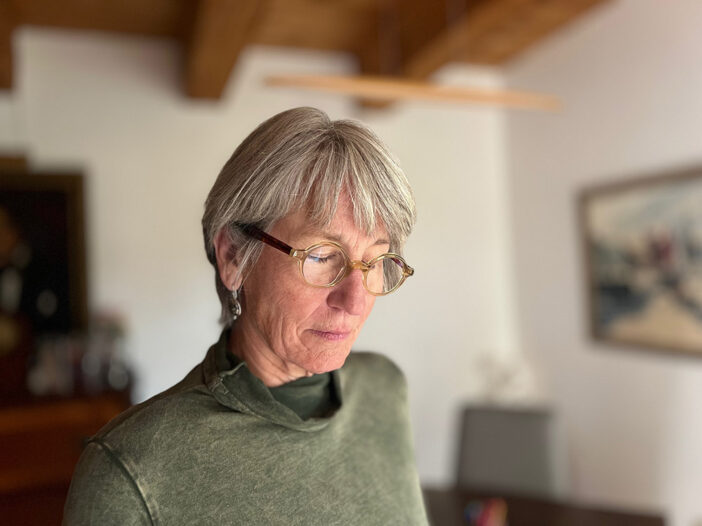
After living in eleven different homes, from California to New York, Alida and her husband retired to a 1902 log cabin in the Chippewa National Forest of northern Minnesota, where they set roots. For eighteen years. Alida had come to think of as their forever home. But one day her husband asked if she wanted to move. At first, she thought,, “Are you crazy?” But when he explained that it was her turn to choose, she thought about it. She had family in Maine, and three children and seven grandchildren already on the East Coast. So, she said yes, and for the next three months they lived on Zillow. Six years ago, they found their home in Waldoboro. Alida has worked in an art gallery, sold antiques, had her own custom-framing business, and worked in personnel matching the right people to the right company. However, throughline in her life has been Hospice where she’s volunteered for some thirty years. It’s a little different in each state. In Maine, Hospice is a service covered by Medicare for people and their caregivers in the last stage of a person’s life, which is sometimes, for some people, is hard to concede. Alida has four wishes: 1) for people to take advantage of the program sooner than the last two weeks; 2) to recognize that they can change their mind at any time, even after they’ve signed up; 3) for doctors to share more readily about the availability of this service more readily with their patients; and 4) for Hospice not to be a word that is frightening.
My brother’s wife was diagnosed with glioblastoma (an aggressive brain cancer) a year after they were married. Towards the end, my brother asked me to help care for her. I didn’t have a job, and I didn’t have children. I spent a month in their house, caring for her, and I didn’t know her very well at all.
We had a lot of fun. We did silly things like dancing together. She was paralyzed on one side, so we did what my father used to do with me, putting my feet on his to dance. I put hers on mine, held her close, and we would dance around the room. She loved that. We both loved that.
And then, I left, and maybe a month or perhaps just two weeks later, she died. And I thought, even in all that loss, what an amazing experience it had been.
But it took me ten years to figure out what to do with it. The light went on when I saw something in the paper about Hospice training. We were living in upstate New York at the time, so I got trained as a Hospice volunteer in New York and did work there; then I trained in Minnesota and did work there; and then I came here.
Each state has different rules but basically you learn about the stages of dying. You understand that you’re working with a team made up of a doctor, a nurse, a social worker, an aide, a pastor and a volunteer. We all work together on each individual case.
You learn that when you enter the room, you need to be open, nonjudgemental, and willing to ask hard questions, if they need to be asked. It can be something as simple as, “Do you understand you’re dying?” Or “How do you feel about that?” A lot of people won’t ask a question like that. Yet dying is one of the most important events in someone’s life. And, while their loved ones might talk about everything else with them, I might be the person who will talk to them about dying.
The first patient I had was a woman who was in a nursing home. Her husband had been caring for her, and he was usually there when I went to visit her. Well, it was maybe my fifth or sixth time there and this time I was alone when I entered her room. She was asleep, which didn’t surprise me because she had been steadily declining. And that happens often when you go in to visit someone. They are sleeping, and what’s needed is for someone just to be present and hold their hand and be there when they wake up.
Anyway, she was sleeping and sleeping and sleeping. And then she started breathing irregularly, which is a sign of shutting down. And then, she died.
I didn’t know what to do. I put my ear next to her mouth and nose to see if I could hear her. Then I called Hospice, because when a patient at a nursing home is a Hospice patient, the Hospice team is their primary caregiver. But I saw a nurse walking down the hall, and I said, “I think she’s died.” And sure enough, she had died.
Then I remembered my training: when Hospice arrives, and when all the medical people are there, and after the family has been notified, you, as the volunteer, you leave. I told myself, “Okay, I have to leave. But I don’t want to leave.” I had to leave a woman I’d had a relationship, and her poor husband whom I had a relationship with, too. So I left. I went to my car and just sobbed.
Leaving is the hardest part of all. You build a relationship with someone at one of the most meaningful times in their life and then you never see them again.
To watch someone deteriorate, and then die, is always hard. However in the beginning, it was harder. You might walk in the first time, and they’re sitting up in a chair, and able to get up and go to the bathroom by themselves. Then, on your next visit, they’re lying in bed having lost weight and not awake much.
If it’s become easier, it’s because now I see dying as a normal process. When a baby comes through a birth canal, that’s an incredibly hard journey. The same is true on the other side, at the end of life.
Touching a total stranger has become easier over the course of thirty years. And so have things like feeding someone; swabbing a mouth out; making sure the oxygen is working properly; just helping someone get comfortable in bed.
They tell you this in training, and I think it’s really true: leave all your beliefs and preconceptions at home– about everything! Walk into a house and say, “This is their house. This is their life. I am just there to support them.”
I took care of a woman whose house was very, very small. She lived there with her two adult daughters. Plus, the partner of one of the daughters. So, they were four adults. And then there were two teen children, three cats, and five dogs. Some of the dogs were in kennels and not friendly. There was always a dog under the kitchen table. When I say small, the house was maybe 20×20. There was stuff everywhere. But it was their house and their home.
I have met people from all walks of life in Hospice – people I might never have made friends with. I am so glad they came into my life. It has been a privilege. They have taught me that death is not something to be afraid of. Even as they are dying, they are still giving and still teaching me and everyone else in the room about death. And about life.
This is what I see when someone dies: they leave the room. Only the body is left behind. It makes me question whether there’s an afterlife. I don’t practice a religion, but I do believe you go somewhere. I just don’t know where.
Leave a Reply