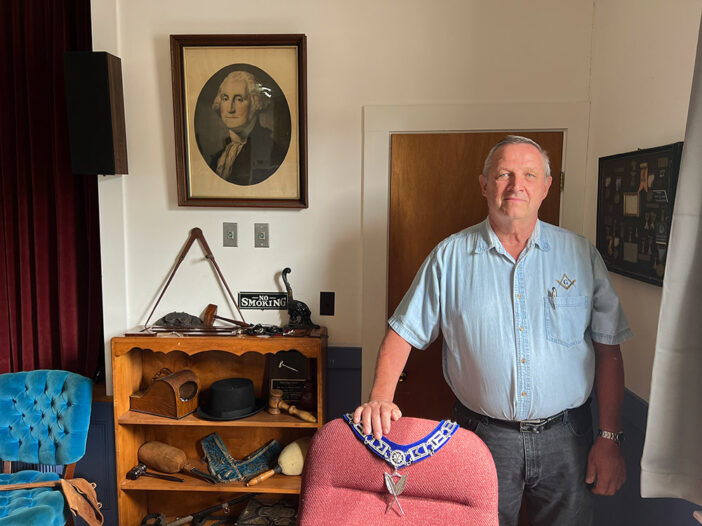
It takes three degrees to become a Master Mason. Alfred McKay of King Solomon’s Lodge in Waldoboro, has mastered 32 full degrees, a commitment he’s made in the 32 years he’s been a Mason -- by studying, learning and memorizing 32 spiritual tenets or themes, such as justice, mercy, faith, goodness and love. Only the 33rd degree remains. The origins of Freemasonry date back to the Middle Ages and the guilds of stonemasons. Although earliest texts go as far back as the late fourteenth century, there is little written and much speculation about the rites and responsibilities for members. But in short, Freemasonry today is a fraternity with three purposes: bettering good men through teachings and understanding; doing good works in the world; and sharing comradeship with each other. The first Grand Lodge was established in London in 1711. By 1762, the Grand Lodge in Portland was chartered, before Maine was even a state. Others followed in villages all over Maine, and in 1855, King Solomon’s Lodge in Waldoboro was chartered. One third of US presidents have been Masons. Others include Benjamin Franklin, Irving Berlin, Supreme Court Justices Earl Warren and Thurgood Marshall, Mark Twain, Oscar Wilde, Louis Armstrong, Henry Ford, Buzz Aldrin, John Elway and Arnold Palmer. And so on. Alfred McKay is the current Secretary of King Solomon’s. He’s an Air Force man, and he joined the Masons when he was posted in Guam. He has also been a Shriner for 30 years. As Alfred puts it, Masons are the serious side and Shriners are the fun side. But service is key to both, done with a comradery of fraternity while accomplishing things that support the community, with the most meaningful being, for Alfred, helping children.
We’re a secretive society, but we are not a secret society. If we was, we wouldn’t have our name on the building. If you come up to the door while we’re in session and you knock on the door and say, “How do I join?”, we’re going to say, “Here you go. Here’s the application.” All fraternities are secretive, like Odd Fellows in Warren or Elks in Rockland, and they all have their little rituals and stuff which I have no idea about because I’m not in any of those.
Masons are here to support the community and to better the lives of the members through religious passages. We are not a church. But with its foundations in England and being brought over by the Pilgrims and everybody else, it’s got its birth from very religious people.
To be a Mason, you have to believe in a supreme being. It could be a Christian God, a Jewish God, a Buddha. It could be any supreme being in whatever your religion is. But if you’re an atheist, you are out the door.
You also have to be a man of good rapport – for example, you cannot have any criminal convictions. I look for sincerity. I want to know that you have a good heart and a kind soul.
You have to ask to join. Right now, we’re down to 45 members here, only which about ten are really active. But we do have twelve who are 50-year members and most of them was raised in Kings Solomon’s Lodge. I’d guess our youngest member is in either late 20s or early 30s.
Lastly, you have to pay your annual dues, and every lodge is different. We’re $35. But I’ll tell you a story about that. After my retirement from the Air Force and moving up here, a couple of years later I fell on hard financial times. All of sudden, my dues was paid, anonymously. So now, if somebody can’t pay their dues, we put it to a vote, and it’s always unanimous that we pay their dues.
And that’s basically it. I would like to see the kids, 40 and below, come when we do our fundraisers or our work-parties here. But most of them are working just to make ends meet. It’s really hard to find young people who have the time to commit to joining. And as Masons, we conduct our rituals from memory. It’s old-school. It’s hard work, and a lot of memory work. The younger generation wants to look at a phone and read it. So, we tend to have a bunch of the more experienced Masons.
I never had any intentions of going as high as I’ve gone in the Masons — I am a past District Deputy Grand Master — but I had mentors that just led me down that path. And it was a good path to be on. I love mentoring people and newer members, be they here or wherever.
I can’t talk much about it, but in working for my 32 degrees, I’ve memorized a lot, and the things I’ve memorized, well, I’ll be doing something and then, a verse or a saying will just click. And I’m like, “Well, okay!” Or, if I’ve promised to help an orphan or a widow, something will just click.
I love being a Mason and a Shriner. I love helping people. I love the work. Like in the wintertime or around Thanksgiving — we might hear about someone who needs help, or we’ll call the Food Pantry, or the churches or the Town Hall, and there’s always a name instantly, and we will take a huge box of food to a young couple with two or three kids, and between the couple, they’re working three jobs, four jobs. And at first, there’s disbelief that somebody would do this. Then they get really emotional.
It gives you such a feeling of joy. But at the same time, it tears your heart out. I don’t know how else to describe it. I wish we could do more. We’re just a small lodge. We do the best we can.
Leave a Reply